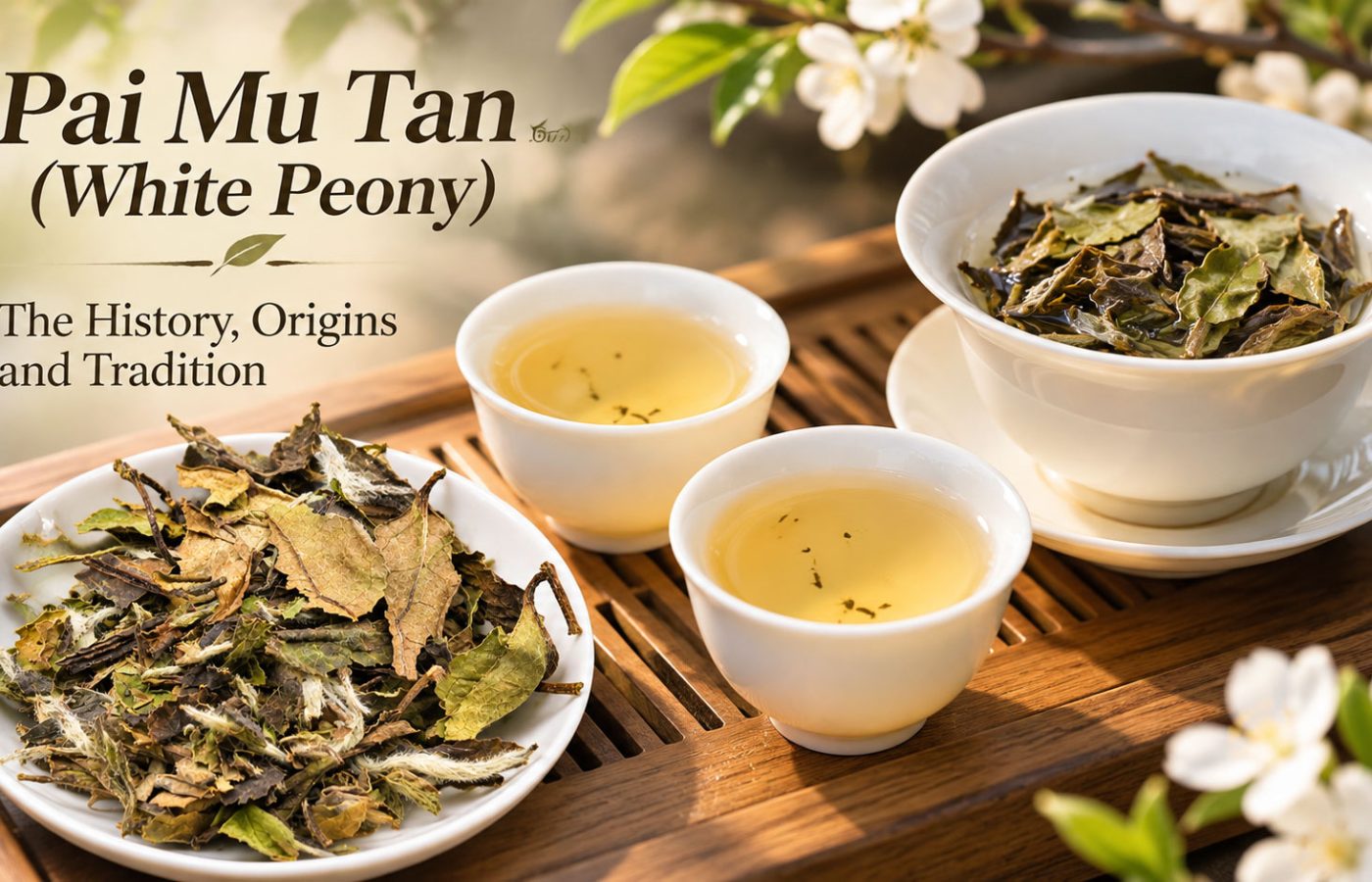
Pai Mu Tan (White Peony): History, Origins, and Tradition

Among China’s traditional white teas, Pai Mu Tan—also spelled Bai Mudan and commonly known as White Peony—is one of the best known and most widely enjoyed. It is traditionally grouped with the four major commercial styles of Chinese white tea: Silver Needle (Bai Hao Yin Zhen), White Peony (Bai Mudan), Gong Mei, and Shou Mei.
The development of modern White Peony tea is generally associated with Shuiji in Jianyang, Fujian Province, where it was being produced by the early 20th century, before 1922.
It is important, however, not to confuse modern white tea with historical references to “white tea” found in much older Chinese texts. For example, Emperor Huizong’s Da Guan Cha Lun (Treatise on Tea) from the Northern Song dynasty described a rare “white tea,” but that tea referred to a particular pale-leaf tea plant and was not the same style of withered white tea produced today.
The Early Development of White Peony
Before 1922: Origins in Shuiji, Jianyang
White Peony developed from the traditions surrounding Silver Needle white tea, which is made primarily from young unopened buds.
Tea producers in Shuiji began harvesting a broader plucking standard—typically one bud with two young leaves. The bud and leaves were covered with fine silvery-white hairs, producing what was traditionally described as the appearance of “three whites”: the bud and both leaves showing visible white down.
Unlike green tea, the leaves were not pan-fired, and unlike many oolong or black teas, they were not heavily rolled. Instead, the freshly harvested leaves were carefully withered and dried, allowing the natural character of the tea to develop with relatively little processing.
When infused, the silvery bud surrounded by green leaves was thought to resemble a white peony flower opening in water, giving the tea its name.
Early White Peony production also included tea made from Shui Xian tea cultivars. This style became known as Shui Xian Bai, or Shui Xian white tea, and represents an important branch of White Peony’s early history.
1920s: White Peony Expands to Zhenghe
By around 1922, White Peony production had spread to Zhenghe County in Fujian Province.
Zhenghe became especially important because of the use of the Zhenghe Da Bai tea cultivar, which produces relatively large buds and leaves covered with fine white hairs.
Traditionally made Zhenghe White Peony became known for a somewhat fuller character than many lighter white teas. It can offer:
- Deep floral aromas
- A fuller, rounder body
- Gentle sweetness
- A lingering tea finish
As production increased, Zhenghe became one of the major centers of White Peony manufacture. Much of this tea was historically produced for export, including markets in Southeast Asia.
1960s: Production Spreads to Songxi
By the 1960s, Songxi, another tea-producing region in northern Fujian, had also begun producing White Peony.
Jianyang, Zhenghe, and Songxi together became important parts of the northern Fujian white tea tradition.
Meanwhile, Fuding was already famous for producing Silver Needle and gradually expanded its production of White Peony. Fuding-grown White Peony eventually developed a strong reputation of its own, often associated with a cleaner, sweeter, and more delicate style.
Today, Fuding and Zhenghe are the two names most closely associated with modern Fujian white tea production, although historic areas such as Jianyang remain important to the story of White Peony.
Postwar Years Through the 1980s: A Tea Made Primarily for Export
For much of the 20th century, high-quality Chinese white tea was strongly oriented toward export markets.
White Peony became particularly appreciated in Hong Kong, Macau, and Southeast Asia, where fine grades were sometimes sold or presented as premium teas.
Traditional White Peony production was highly dependent on weather conditions. Because careful withering plays such an important role in the finished tea, producing consistently high-quality batches could be difficult.
As a result, premium White Peony was produced in relatively limited quantities compared with more widely manufactured Chinese teas.
For many years, Chinese consumers were therefore less likely to encounter high-grade White Peony than customers in established export markets.
After 2000: The Rise of Aged White Tea
Historically, much of China’s white tea was sold as loose-leaf tea and consumed relatively young.
During the 2000s, however, interest in aged white tea grew dramatically in China.
Tea drinkers and collectors increasingly began storing white tea for longer periods and observing how its aroma, body, sweetness, and overall character changed with age.
This movement helped popularize the saying:
“One-year tea, three-year medicine, seven-year treasure.”
This traditional marketing and folk expression should not be interpreted as a medical claim. It reflects the cultural value placed on aged white tea rather than established medical guidance.
As aged white tea became increasingly popular, producers also began compressing White Peony into tea cakes, making the tea easier to store, transport, and age.
Interest in aged White Peony helped bring even greater attention to Fuding white tea, and today both Fuding and Zhenghe are recognized as major sources of high-quality White Peony.
Traditional White Peony Styles
Although all are considered White Peony, the tea’s character can vary depending on cultivar, growing region, harvest, and processing.
Zhenghe Da Bai
Traditionally associated with Zhenghe White Peony, Zhenghe Da Bai develops relatively large buds and leaves with abundant fine hairs.
Its style is often described as:
- Richer and fuller-bodied
- Deeply floral
- Smooth and substantial
- Well suited to traditional White Peony production
Historically, Zhenghe White Peony was also an important export tea.
Fuding Da Bai and Fuding Da Hao
These cultivars are widely used in modern Fuding white tea production.
Fuding White Peony is often appreciated for its:
- Natural sweetness
- Fresh floral aroma
- Delicate texture
- Clean, elegant finish
This brighter and gentler style has become particularly popular among today’s white tea drinkers.
Shui Xian White Tea
One of the older styles associated with the Jianyang and Shuiji tradition, Shui Xian white tea is produced from Shui Xian cultivar material.
It may display some of the distinctive aromatic character associated with Shui Xian while retaining the soft processing style of white tea.
Today, it is much less common than White Peony made from Fuding or Zhenghe cultivars, making it an interesting part of white tea history.
Why Is It Called White Peony?
The name comes from the tea’s appearance.
Traditional White Peony is usually plucked with one silvery bud and two young leaves. As the leaves rehydrate during brewing, they slowly spread outward around the pale bud.
To early tea makers and drinkers, the appearance resembled a white peony blossoming in water.
That visual resemblance gave the tea its poetic Chinese name, Bai Mudan—白牡丹, meaning “White Peony.”
There are also folk legends describing a peony transforming into a tea plant. These stories add color to White Peony’s cultural tradition, but they should be understood as folklore rather than documented tea history.
White Peony Today
Today, Pai Mu Tan occupies a beautiful middle ground within the world of white tea.
Compared with Silver Needle, which consists primarily of buds, White Peony includes both buds and young leaves. The additional leaf material generally creates a cup with more body, deeper aroma, and a broader range of flavors, while still maintaining the gentle character associated with white tea.
Depending on origin and processing, a well-made White Peony may reveal notes of fresh flowers, hay, honey, melon, stone fruit, herbs, or soft dried fruit.
It can be enjoyed young for its fresh and floral character or carefully stored to explore how white tea changes with age.
More than a century after its development in Fujian, White Peony remains one of the most approachable ways to experience the craftsmanship, history, and subtle complexity of traditional Chinese white tea.